Current Thoughts
Regardless of whether or not you have been approved for the YouTube Partner Program (YPP), your top priority every day should be to publish YouTube Shorts.
This is because, as of now, YouTube still provides Shorts with a certain amount of initial exposure. As long as the content isn’t abysmal, it is highly unlikely to receive zero views (conversely, getting zero views on a long-form video is quite common).
Furthermore, the difficulty and time required to create Shorts are orders of magnitude—dozens of times—less than that of long-form videos. You can simply shoot something off the cuff—taking just a dozen or so seconds—and potentially generate a massive amount of traffic.
Even if you don’t get any traffic, the only cost to you is a mere few minutes of your time (whereas editing a long-form video typically takes anywhere from half an hour to several hours—or even a full week to produce a single video—since most people can only edit in the evenings after finishing work).
Therefore, I recommend the following:
For whatever reason, make it a rule to publish at least one Short before you even consider publishing a long-form video—even if that Short consists of nothing more than filming your ceiling and appears completely meaningless.
Alternatively, for every long-form video you publish, you should make a point of simultaneously editing it down into a Short to release as well (this ensures that you still meet your baseline goal of publishing at least one Short).
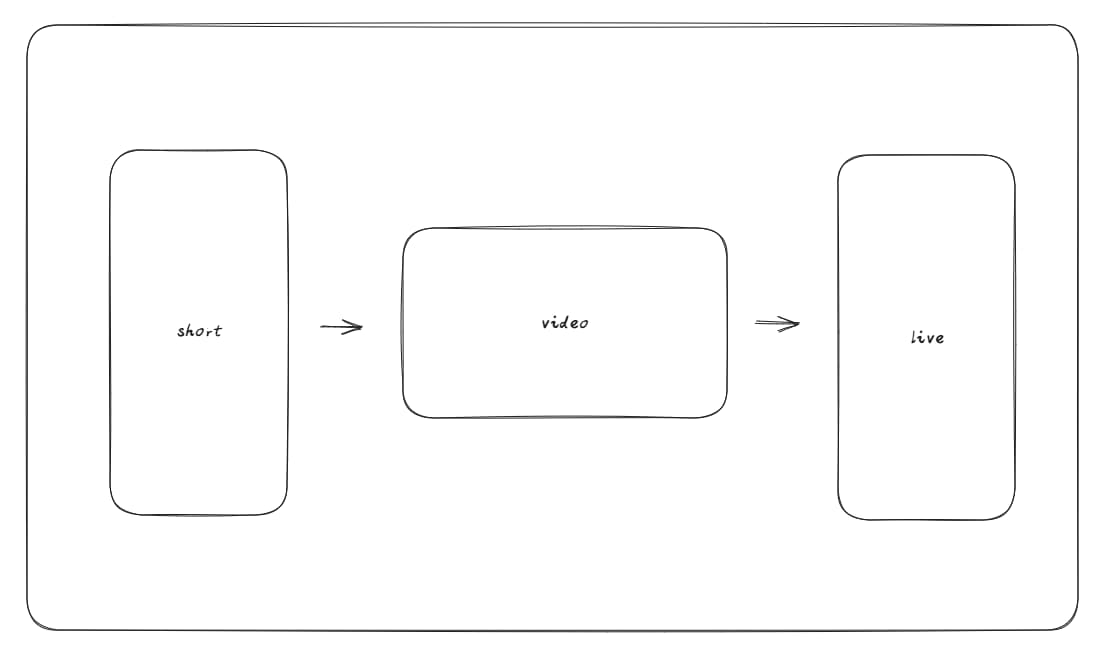
Shorts can help you gain subscribers, while long-form videos can generate higher revenue; live streams remain a separate category (as their primary value lies in real-time interaction).
Trending Topics
The media landscape is—and always will be—driven by trending topics.
Take, for instance, the newly released Gemma 4 local large language model, or the recently open-sourced Qwen 3.6 (35B/3B) local models.
We are now living in the “Token Era.” If you remain fixated on traditional, old-school programming methods, few people will bother watching your content; after all, everyone else is currently using AI—and learning about it, too.
Consequently, your short-form videos need to fall into one of two categories: either they feature universally appealing content—like adorable kittens—that generates broad traffic, or they focus specifically on AI-related topics to capture audience interest.
One of the key advantages of short-form video is that viewers can immediately see your content without needing a dedicated thumbnail (meaning you don’t have to spend time meticulously optimizing titles and cover images).
I just casually shot a short video—about 15 seconds long—showing off my home lab setup. Since I’m still a complete beginner at this, there’s no need for me to deliberately manufacture “trending” content solely for the sake of chasing traffic.
In these early stages, I simply intend to shoot whatever strikes my fancy—prioritizing the timely capture and publication of the ideas I want to share.
I’ll leave the rest to the algorithms and the flow of traffic; whichever videos gain the most traction, I’ll simply create and publish more short-form or long-form content along those same lines.
Below is the short video I just casually put together.
Keep Recording and Reflecting
My articles are not tutorials; they serve to document my own journey—specifically, my YouTube traffic and earnings.
It is a process of continuous documentation, reflection, analysis, and optimization.