Umami Analytics Data
Currently, I prefer checking my Umami analytics data; it is much simpler and clearer than Google Analytics.
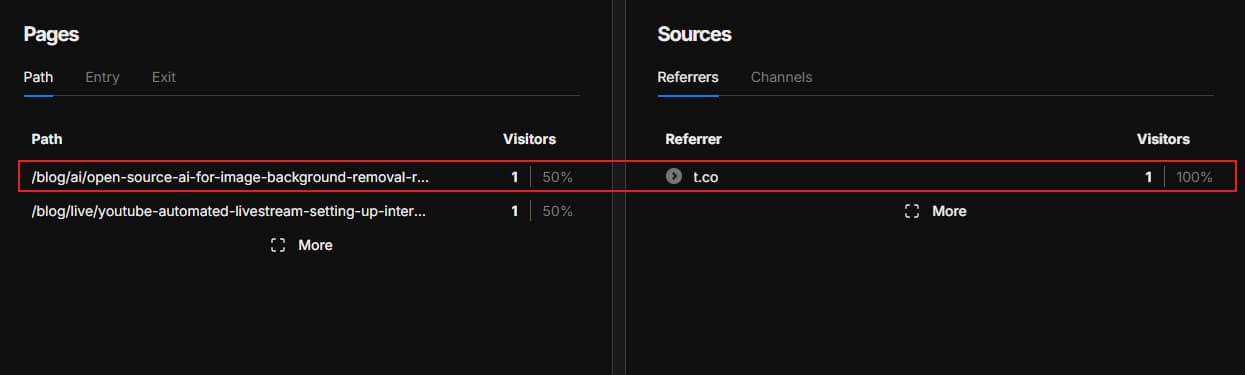
I noticed that my blog received one visit today, which originated from a click on X (formerly Twitter). The article clicked on was about “rembg”—an open-source, AI-powered “all-in-one package” for background removal.
To the best of my recollection, this marks the very first instance of organic traffic my new blog has received in the roughly ten days since its launch.
So far, neither Google nor Bing search engines have generated any traffic.
I also posted on Reddit, including a link to my blog; while the post has garnered 180 views to date, it hasn’t resulted in any click-through traffic.
I’ve also published around ten videos on YouTube, yet no one has clicked on the blog link provided in the video descriptions.
Consequently, I plan to experiment with increasing the frequency of my image-and-text posts on X in an effort to drive traffic to the blog.
Blog Website Keywords
I recently had another long chat with a friend. We discussed the evolution of my blog: from its inception—where I documented SEO strategies and the Astro framework—
to a later phase focused on operating long-form YouTube videos, and finally to my current focus on automated, unattended YouTube live streams.
The conversation shifted from simply keeping a personal diary to identifying a specific niche. As a result, I’ve decided that—starting today—my blog will prioritize content related to the ESP32 microcontroller.
I’ve noticed that both Google Search Console and Bing Webmaster Tools feature sections dedicated to keywords—implying that a blog needs to center around a core keyword or theme.
Previously, my content was quite eclectic; I wrote about a little bit of everything. However, none of those posts generated any traffic—and, truth be told, I wouldn’t even bother reading most of them a second time myself (with the exception of technical content like code tutorials).
I’ve seen other bloggers achieve massive traffic by creating content like “1,000 Ways to Use a Raspberry Pi.” Inspired by that success, I now intend to compile a similar collection: “1,000 Ways to Use an ESP32.”
The reasoning behind this choice is as follows:
Development boards like the Raspberry Pi—as well as mini-PCs and similar devices—have seen their prices steadily rise. The cost has become prohibitively high, making them unaffordable for many people.
The ESP32, on the other hand, is relatively inexpensive. Furthermore, it boasts a wide range of practical applications—such as monitoring temperature and humidity, controlling drones, building robotic cars, and powering smart home systems. It is a device that the average person can realistically afford to buy, experiment with, and utilize effectively—making it a highly practical and relevant choice.
Therefore, I plan to structure my website’s core keywords around terms such as “ESP32,” “Smart Home,” and “IoT” (Internet of Things).
AI Programming
Today, I gave the VS Code extension “Cline” a try; it currently boasts 65k stars.
I used a local large language model—Qwen 3.6 (35B-A3B)—to test a single-page Node.js script. The token generation speed was quite slow, though it handled the lightweight code without any issues.
However, I really wish it were faster. As things stand, the speed and overall user experience of local LLMs fall far short of their paid counterparts—to the point where standard conversational programming feels like a superior option.