Data Analysis
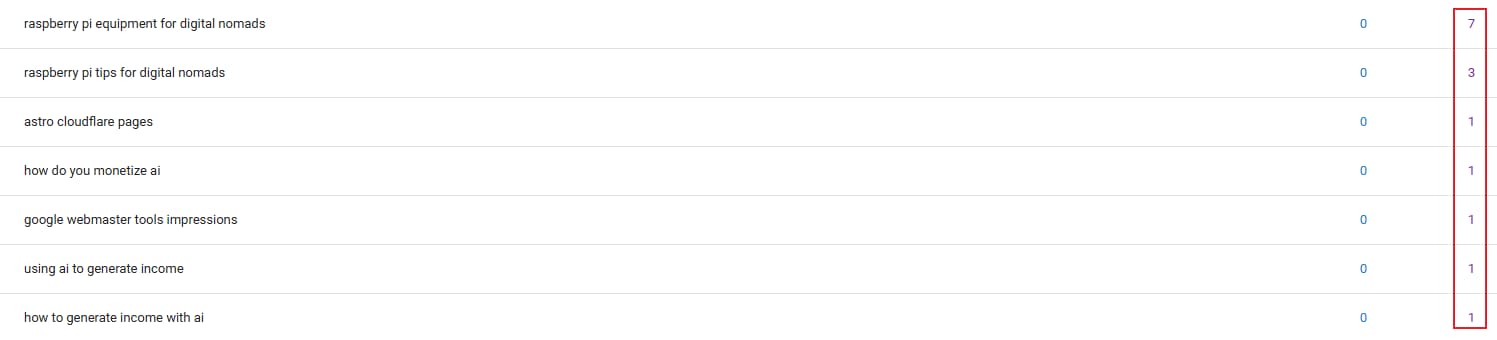
Below is the 7-day data from Google Search Console for my blog site.
As you can see, the first two entries show display counts that are significantly higher than the others.
One keyword is “Raspberry Pi,” and the other is “Digital Nomad”; the actual search intent likely represents a combination of these two terms.
Based on my analysis, writing solely about the Raspberry Pi might not attract organic search traffic; the user base for that topic tends to consist of “geeks” and computer enthusiasts.
Similarly, writing solely about “Digital Nomads” is unlikely to yield search traffic either. This is because “Digital Nomad” is a “red ocean” topic—everyone is writing about it, and everyone is running travel blogs—making it extremely difficult to gain visibility through keyword searches alone.
However, the specific combination of “Raspberry Pi for Digital Nomads” represents a potential niche keyword. While niche, it undeniably corresponds to a specific, existing demographic.
Just as digital nomads might choose to travel in RVs, vans, cars, or even bicycles, the concept of a “sleeper car” (a vehicle modified to accommodate a bed) also emerges as a relevant keyword within this context.
In the past, I spent a great deal of time tinkering with a “homelab”—primarily centered around the Raspberry Pi. I chose the Pi because of its compact size, its rich open-source community, and its compatibility with the open-source hardware ecosystem I wished to integrate.
Raspberry Pi
However, my early experiments with the Raspberry Pi were primarily for personal entertainment purposes—such as setting up my own music streaming platform, building a personal media server for movies and TV shows, or creating a gaming hub. This allowed me to enjoy a high-quality, ad-free, and entirely personalized digital experience (though, naturally, none of these projects generated any revenue).
Later, I leveraged the Raspberry Pi to build the infrastructure for my “one-person company.” Using Docker, I deployed a suite of services—including Gitea (for code hosting), documentation platforms, chat rooms, prototyping tools, Umami (for data analytics), and ntfy (for push notifications). In total, I deployed over a dozen distinct services—including, but not limited to, Nextcloud (for office productivity), password managers, drawing tools, Excalidraw (for digital whiteboarding), and the Caddy web server. …SSL, databases, and the like—all for the purpose of independently developing apps and websites (though, admittedly, I haven’t made any money from it yet).
However, the Raspberry Pi has gone through two price hikes: once due to a general market-wide chip shortage, and a second time due to chip shortages driven by the AI boom. These development boards, once so affordable, are no longer cheap. Consequently, I rarely use them anymore; instead, I’ve switched to the Orange Pi—a more affordable alternative that is also much more compatible with SSDs. (Although the Orange Pi has also seen price increases recently, fortunately, I’m still using one of my older boards.)
Why the Raspberry Pi?
Because it is incredibly compact. For a digital nomad, it is perfectly portable—roughly the size of a human palm or a credit card. In terms of performance, it functions as a miniature computer, capable of handling most tasks that a standard PC can perform. (It also supports open-source mobile operating systems and can even be utilized as a “cloud phone” or similar device.)
Furthermore, it operates on a 5V power supply. This means you can power it using a portable power bank or a computer’s USB Type-C port. You can boot it up in almost any setting, and—compared to the ~220V required by a desktop PC (which must be plugged into a standard wall outlet)—it offers a much safer operating voltage. For a digital nomad, this is a huge advantage: you can power it using solar energy (something a desktop PC cannot do), allowing you to fire up your Raspberry Pi computer anytime, even when you are out in the wilderness.
It also allows for integration with physical devices. Equipped with built-in GPIO pins, it can interface with sensors—such as those for temperature, humidity, or light levels—to read real-world physical data. Through protocols like MQTT or via the GPIO pins themselves, it can control physical hardware—such as triggering relay switches or controlling lighting effects. Its machine vision capabilities, in particular, are excellent for security systems or other specialized applications. If I were a digital nomad, I would set up monitoring systems in both my RV and my home to track temperature, detect fires, monitor air quality, and automate device interactions—such as linking door sensors to control the lighting.
Servers
The Raspberry Pi can also serve as a dedicated server—perfect for hosting your own personal blog, a utility website, a media streaming service, or similar projects.
I previously hosted several of my blogs on an Orange Pi development board. However, due to a lack of traffic—and because I’ve decided to focus my efforts on maintaining only this specific blog—I have since taken those Orange Pi-hosted websites offline.
Some might ask: Wouldn’t a digital nomad be better off carrying a sleek, lightweight MacBook laptop, or simply keeping a Mac Mini at home to serve as a dedicated server? If you have the budget, Apple products—such as Macs and iPhones—are certainly excellent choices. However, if you are looking for a low-cost, compact computing solution, a Raspberry Pi or an Orange Pi would be a far better option.
My Recommendations
First, regarding my current blog site, I have chosen Astro as the underlying technical framework.
Second, I have opted to deploy it on Cloudflare Pages. (While I could have chosen to deploy it on a cloud server or even directly on my Raspberry Pi development board, I prioritized Cloudflare Pages to avoid worrying about power outages, network connectivity issues, or other inexplicable system errors.)
However, this is precisely where the true utility of the Raspberry Pi development board comes into play.
First, I installed Gitea—a version control system—on the Raspberry Pi board to synchronize my Astro project files with a local Git repository on the device. (This serves as both a backup and a synchronization mechanism—a good habit to cultivate to ensure you never lose your blog content.)
Second, I installed Umami Analytics and integrated it into my Astro blog site. This allows me to collect and analyze my own website data. (Note that this does not interfere with simultaneously using Google Analytics.)
Third, I installed Uptime Kuma to monitor the blog site’s accessibility and check for SSL certificate expiration. If any anomalies are detected, it sends immediate notifications. (This serves as my website monitoring system.)
Fourth, I installed ntfy—a notification service—to work in tandem with Uptime Kuma. When an anomaly is detected, it sends a push notification directly to my Android smartphone. (You can also configure custom scenarios to trigger notifications—for instance, whenever a user visits the site, initiates a support request, or posts a comment.)
Fifth, I installed a Markdown-based note-taking tool—specifically ShowDoc—which allows me to edit my notes directly via a web interface and then publish them to my Astro blog. (While this step isn’t strictly mandatory, it is absolutely essential for me personally, as I use ShowDoc daily to record my notes and draft my blog posts.)
Blog Traffic
Currently, I’ve experimented with two approaches:
The first was YouTube; I plan to abandon this, as I simply can’t be bothered to record videos.
The second was sharing content on X (formerly Twitter); I intend to drop this as well, since it generates virtually no traffic whatsoever.
I’ve decided to forgo social media entirely—and I won’t attempt paid promotion either. Instead, I aim to acquire all my impressions and clicks exclusively through search engines—specifically Google. For the time being, I won’t bother researching Bing; if I happen to have some spare time, I might submit my sitemap as a mere formality. Unless Bing eventually surpasses Google in traffic volume, I can get by just fine without it.
My current strategy shifts away from “results-oriented content” toward “reflective content”—sharing and documenting the process itself. The content isn’t meant to be a polished success story or a collection of “best-of” highlights; it might be messy or imperfect, but it will always be authentic.
Take this very article, for instance: it’s essentially my rough draft. I plan to update it daily—whenever an idea strikes me, I’ll post it directly without feeling the need to meticulously polish or structure it.
Of course, before hitting “publish,” I might give it a quick touch-up—removing any sensitive information, bolding key points, or formatting details into lists, tables, or charts.
My goal for today is to contemplate the thematic scope of my blog. Producing “results-oriented content”—such as tutorials on using an ESP32 for smart switches—requires a rigorous workflow: testing, experimentation, achieving a successful outcome, and finally, compiling detailed notes. Since that entire process often results in zero readership, I simply can’t be bothered to go through it anymore.
My current line of inquiry is this: how can I foster organic traffic growth for my blog—starting from Google Search—without relying on social media platforms like YouTube or X?
I’ve been reviewing my data in Google Search Console. Although I haven’t generated any clicks yet, I am definitely getting impressions. I’ve already documented the specific content that’s generating these impressions at the top of this article. By adopting a “data-driven content” approach, I realize that—in addition to the AI-related topics I initially focused on—I can also expand into content exploring the intersection of Raspberry Pi and the “digital nomad” lifestyle, to see if those topics yield even more impressions and clicks.
I also checked my Bing Webmaster Tools data. Aside from my own internal searches (using the site: operator to check my own domain), I’m receiving absolutely zero traffic from anywhere else. Bing is truly useless.
Topics of Interest
Over the past few days, while browsing various forums on Reddit, I’ve repeatedly come across discussions regarding: Google releases the Official AI SEO/GEO Guide
Reading through the content gave me a headache; simply put, it confirms that traditional SEO practices remain effective, while also acknowledging the integration of new AI features.
Personally, I found nothing in it worth studying or improving upon. My sole takeaway is this: in an era where AI is becoming increasingly commonplace, one’s own unique, independent experiences constitute the only truly valuable content.
For instance—encounters with aliens during childhood, paranormal incidents, or other extraordinary tales—provided, of course, that they are rooted in reality.
Take, for example, my current endeavor to learn about and manage this blog. Although the market is already saturated with best-selling books, comprehensive video courses, countless similar blogs, sub-communities on platforms like Reddit, and AI tools such as ChatGPT or Gemini…
These resources can effortlessly instruct you on how to build and operate a blog. However, they offer only the methodology—not the actual experience, nor the real-world data.
My blog has now officially been active for 30 days, with 30 articles published. It currently receives zero visibility on Bing, while Google has indexed and displayed it—though it garners virtually no clicks.
I experimented with various themes—travel, food, finance, and technology—before pivoting to AI and the “digital nomad” lifestyle, and finally settling on my current format: a running log of my daily progress. I’ve also tracked the amount of time I’ve invested in these shifts.
If, at some point in the future, I wish to analyze how my content is cited or referenced by AI systems, I will return to this very article to conduct my research.
Reflections
I spent today writing a few stream-of-consciousness entries, all while grappling with a persistent question: How does one generate traffic quickly?
To drive traffic via Google Search Console, one must secure high visibility through popular search queries. Only when the volume of “impressions” (times your content is displayed) increases does the opportunity for actual “clicks” arise.
So, what kind of articles are most likely to be searched for and displayed? Presumably, those covering recent trending events—particularly those that align with Google’s own strategic interests.
What, then, is currently trending and relevant to Google? Precisely what I mentioned earlier: the official Google SEO documentation and topics related to Generative AI.
But once I’ve documented this specific content… what comes next? What should the next topic be? I don’t want to be constantly searching for and curating content in a calculated manner; what I want is to earn money while doing things I enjoy—rather than constantly trying to please users and the platform.
I feel that the “digital nomad” lifestyle is something I need to actively research; specifically, generating revenue through Google Ads and affiliate commissions on blogs is a key area I intend to focus on.
My friends enjoy browsing X (formerly Twitter) and keeping up with the news and updates posted there.
Personally, however, I prefer Reddit—specifically following subreddits related to interesting topics, blogging, or YouTube. At the moment, though, I can’t think of any Reddit content that Google would typically choose to feature in its search results.
For now, I plan to just browse through Reddit casually.
Other Notes
It suddenly occurred to me: my social media feeds have been buzzing with claims that the U.S. government has declassified top-secret files regarding UFOs and extraterrestrials.
However, it seems that as of late, there hasn’t been any further news or updates on the matter.