YouTube Beginner
As of right now, I am still a complete YouTube novice; I have absolutely no idea how to run a channel that generates both traffic and revenue.
However, after discussing this with a friend last night, I decided to focus on the field of AI. This choice holds significance in two key ways:
First, it allows me to document topics related to AI.
Second, it involves using AI to create video content (or utilizing AI to assist in the content creation process).
As everyone knows, the mainstream content categories on YouTube typically include food, technology, personal finance, consumer electronics, unboxing videos, car reviews, and gaming—along with other popular niches such as makeup, dance, and fashion.
Why are these areas so dominant? Because the advertisers in these sectors are extremely well-funded; they are willing to pay top dollar to run advertisements, which, in turn, attracts a multitude of content creators to produce material tailored to these specific fields.
Categories like food, technology, consumer electronics, dance, and gaming are all accessible to the average person and transcend national borders.
If the invention of textile machinery marked the Industrial Revolution, and the advent of computers and automation defined the Second Industrial Revolution, then the “Third” and “Fourth” revolutions—and indeed, the era we are living in right now—are all about AI.
AI has already eliminated jobs for countless people. The entire world is undergoing transformation driven by the AI advancements of tech companies—often, an entire industry can vanish seemingly overnight.
From an advertising perspective, tech companies currently represent the most lucrative advertisers; they pay the highest rates and spend the most on ad placements—examples include Google AI, OpenAI, Microsoft AI, and various other AI providers.
In our daily lives, people everywhere are beginning to engage with AI—whether through AI programming, AI-generated art, AI-driven robotic factories, AI-assisted document creation, AI video production, and so on.
This is no longer merely a game; it has become a matter of survival.
Therefore, it is imperative to prioritize AI-related content. YouTube is currently flooded with both short-form and long-form AI videos, and virtually all content that successfully generates significant traffic revolves around AI-related topics.
For instance, if I were to talk about a Raspberry Pi, an ESP32, or PDF files, you might not necessarily be familiar with them. However, if I mention Google’s Gemma 4 or Qwen 3.6, chances are you would recognize them.
If I bring up tools like Codex, Cursor, OpenClaw, Gemini, Grok, or ChatGPT, you would undoubtedly know exactly what I am talking about.
This is because you are either actively using these tools yourself, or every social media platform you use is relentlessly recommending related content to you—whether through advertisements, videos, blog posts, or other media.
Consequently, YouTube creators across the platform are all urging their audiences: “Start using AI to manage your YouTube channel—and do it now!” They emphasize that this is the undeniable trend of the future; moreover, they stand to earn affiliate commissions, and the platform itself is actively boosting the reach of such content.
About AI
So, here are the big questions:
What exactly is AI? How can I stay up-to-date with the latest AI developments? How can AI assist me in managing my YouTube channel? And what kind of AI-related content or topics work best for YouTube?
I don’t have all the answers yet—I’m still in the testing phase.
However, my hunch is that you should start by experimenting with AI products from major tech companies—such as local large language models like Gemma 4, or coding tools like Codex—simply because these companies actively market and promote their offerings.
It’s worth noting that AI has captured the attention of the general public as well. For instance, largely due to the buzz surrounding OpenAI, Mac computers saw a sudden surge in price overnight and went into short supply; everyone is afraid of falling behind the curve.
Currently, I primarily use Stable Diffusion WebUI for generating images; LTX 2.3 for creating short AI videos; Rembg for removing backgrounds from images of people; and Ultimate Vocal Remover to isolate background audio while stripping out vocals. I also utilize AI tools to generate subtitles and voiceovers. For conversational interactions, document organization, and working with local large language models, I rely on ChatGPT or LM Studio (specifically the Qwen 3.6 35B model); and for programming and writing code, I turn to Codex and Cursor.
On my blog and video channels, the content currently generating the most traffic—in terms of both video views and article reads—is a casual post I wrote about using the local large language model Qwen 3.5 35B, specifically covering how to disable its “thinking mode.”
I’ve observed other content creators—bloggers and YouTubers—who previously focused on niches like food and travel but struggled to gain traction. However, after pivoting to AI-related video content just six months ago, their traffic skyrocketed—increasing by more than tenfold. It seems that any video centered around AI is currently a hot commodity.
Therefore, if you are just starting out on YouTube, I highly recommend creating a dedicated channel specifically for discussing AI topics, exploring AI trends, and sharing your own insights and practical applications of AI.
Special Notice
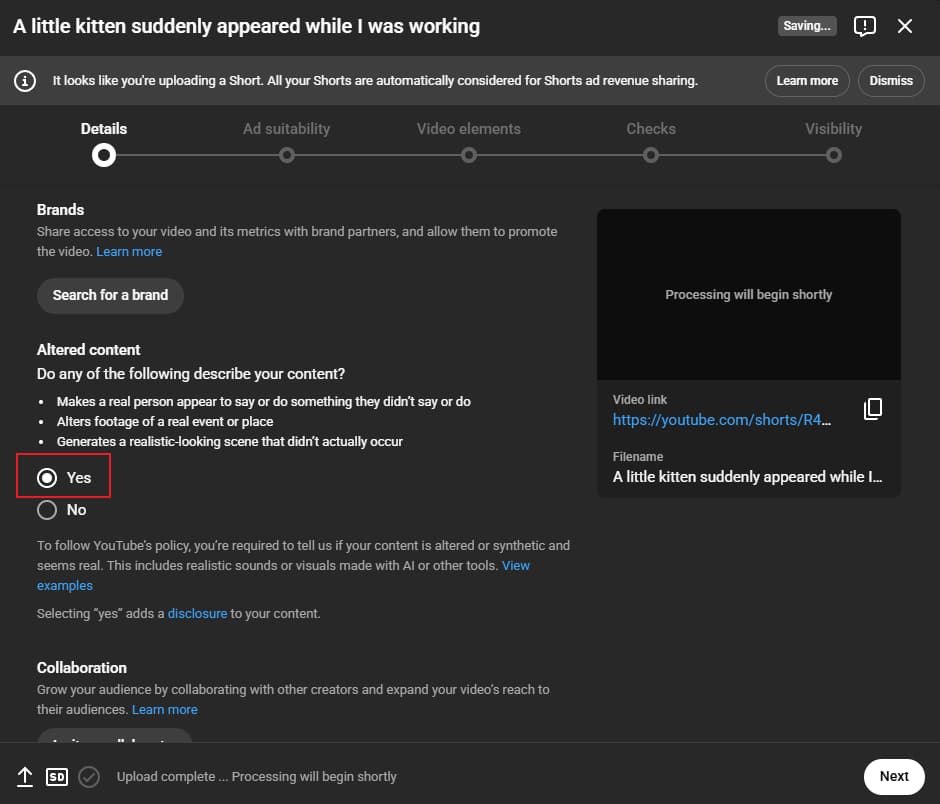
If you create videos using AI, it is strongly recommended that you explicitly disclose to the platform or your audience that the content was AI-generated.
For example, when configuring video upload settings on YouTube:
Please make every effort to select “Yes” in the area marked by the red box to avoid potential penalties from the platform.