Automation
Previous automation involved automation scripts, such as Python code or scheduled tasks.
Most of these were web crawlers, mobile automation, or game automation, often bordering on gray areas or used for some office automation.
Open-source options include QingLong Panel, which supports Node.js, Python, Shell, and other scripts.
Current automation involves AI, including but not limited to OpenClaw, Hermes, and the latest Grok Bot, among others.
| Project | General Positioning | Self-Deployable | Features |
|---|---|---|---|
| OpenClaw | Personal AI Agent | ✅ | All-rounder, messaging platform, tools, long-running |
| Hermes Agent | Personal AI Agent | ✅ | Autonomy, memory, skills, long-term tasks |
| ZeroClaw | Lightweight Agent | ✅ | Rust, very low resource consumption |
| NanoClaw | Secure Agent | ✅ | Container isolation |
| PicoClaw | Ultra-lightweight Agent | ✅ | For low-spec devices |
| IronClaw | Secure Agent | ✅ | Rust + WASM sandbox |
| NanoBot | Minimalist OpenClaw alternative | ✅ | Python, very small codebase |
| Agent Zero | General Autonomous Agent | ✅ | Can create/invoke sub-agents |
| OpenFang | Autonomous Agent | ✅ | More emphasis on autonomous execution |
| AstrBot | AI Agent / Bot | ✅ | Domestic ecosystem, QQ/Telegram/Discord, etc. |
| QwenPaw | Qwen-series Personal Agent | ✅ | Alibaba ecosystem |
| NemoClaw | NVIDIA Agent | ✅ | NVIDIA’s Agent security/runtime solution |
Specific Use Cases
- Manus — Cloud-based General Agent
- Claude Cowork — Claude’s Computer/Work Agent
- Perplexity Computer — Browser + Computer Operation Agent
- ChatGPT Agent / Operator — Browser and Task Execution
- Grok Bot — AI teammate, capable of logging into websites, operating tools, executing multi-step tasks, and collaborating with multiple bots.
- OpenHands — AI Software Engineer
- Claude Code — Coding Agent
- Codex — Coding Agent
- AutoGPT — Veteran Autonomous Agent
- CrewAI — Multi-Agent Collaboration
- AutoGen — Multi-Agent Framework
- LangGraph — Agent Workflow/Orchestration
- Dify — Agent + Workflow Platform
Personal AI Assistant
Hiring a personal assistant in reality costs a significant amount of money, but AI can perform related tasks well, often for free, and privacy can also be protected.
I’m fed up with spending a lot of time publishing YouTube videos only to earn $0.01 and get almost zero views.
I’m also tired of original blog posts being deemed low-value or AI-generated content, simply because search engines themselves are garbage. I will no longer deliberately spend a lot of time on so-called originality. Instead, I’ll research AI automation for information organization. If it succeeds, there’s a big payoff; if it fails, there’s no loss. I only need to invest a small amount of time in the automation creation process.
The same goes for X (Twitter); platforms are all about capital, and profit is key. I’ve never seen quality content on any platform—it’s either ads or entertainment. Therefore, truly valuable information is deliberately hidden by mysterious forces, such as cancer treatments or new energy solutions. Anything that alters profit distribution is concealed.
I can test the effectiveness of automation, starting to experiment with it while maintaining originality and daily routines.
Again, failure is not scary; not trying is the scariest thing. Moreover, the cost of automation is far lower than the cost of making mistakes in life, at least it won’t threaten life or massive wealth.
Technology Choices
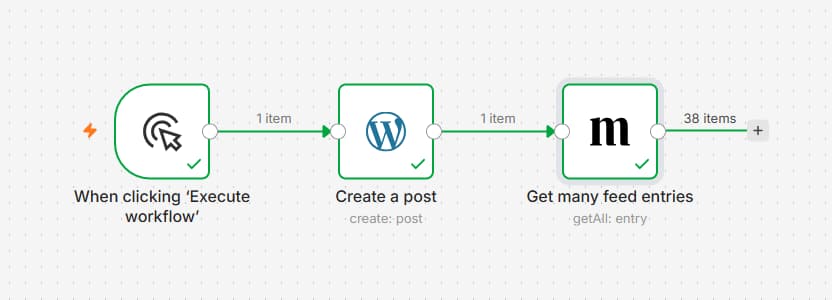
Currently, I’ve chosen n8n + local large model (LM Studio). The goal is to experiment with AI aggregating information and then publishing it to a blog, mainly focusing on AI-related, automation-related topics, and my own interests.
I’ll see if an AI-generated blog over a week or a month performs better than my current manually written blog. If so, then I can only conclude that my four months of manual blogging were a complete waste of time, and this world simply doesn’t favor honest people.
For blog automation, I chose WordPress because of its good SEO performance and excellent plugin and API ecosystem. It can be easily integrated with n8n, which I’ve already done, and it can publish draft content normally.
For information sources, I’ve chosen RSS and Miniflux, which also integrate well with n8n, and I’ve already set that up.
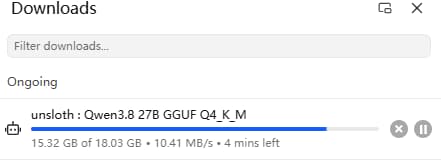
The most crucial remaining step is integrating the local large model, Qwen 3.8 27B. I don’t have a graphics card, only a CPU and 64GB of RAM. However, as long as it runs normally, even if token generation is slow, it’s fine for automation tasks. I can accept starting the automation while I sleep.
Local Large Models
The most critical part of the entire process is AI.
I’ll start by trying a larger model, and if it doesn’t work, I’ll gradually switch to smaller ones, like 14B or 7B. Currently, 35B and 27B are my priorities.
Tips
Once one automation is completed, others become very convenient.
Start with the simplest first.